
There’s nothing better than a warm, crispy bagel in the morning. When toasted the right way, the outside becomes golden and crisp while the inside stays warm and slightly soft.
So, how long does it take to toast a bagel in the oven? For most fresh bagels, 3 to 5 minutes at 375°F is a good starting point in a conventional oven. However, the exact time depends on the bagel type, thickness, starting temperature, and your oven.
I’ve tested different bagels and oven settings over the years, and I’ve found that a few small adjustments can make a big difference. Whether you’re making a plain bagel, everything bagel, thick bakery bagel, or frozen bagel, this guide will help you get the texture you want.
:max_bytes(150000):strip_icc()/__opt__aboutcom__coeus__resources__content_migration__serious_eats__seriouseats.com__images__2015__08__20150822-toast-whole-bagel-2-95a6c514f75b48f2b87bb28d3db6a206.jpg)
How Long to Toast a Bagel in the Oven?
For a typical fresh bagel, preheat your oven to 375°F and toast the sliced halves for about 3 to 5 minutes.
Start checking at 3 minutes. If the cut surface looks lightly golden and the edges feel crisp, your bagel is ready. If you prefer a darker, crunchier texture, add another 1 to 2 minutes.
Here is a quick guide:
| Bagel Type | Oven Temperature | Approx. Toasting Time |
|---|---|---|
| Fresh bagel | 375°F | 3–5 minutes |
| Day-old bagel | 375°F | 4–6 minutes |
| Frozen bagel | 375°F | 5–7 minutes |
| Thick bakery bagel | 375°F | 6–8 minutes |
| Thin, soft bagel | 375°F | 2–3 minutes |
| Convection oven | 350°F | 2–4 minutes |
| Broiler | High | 1–2 minutes |
These times are starting points, not strict rules. Oven temperatures vary, so keep an eye on your first batch and adjust from there.
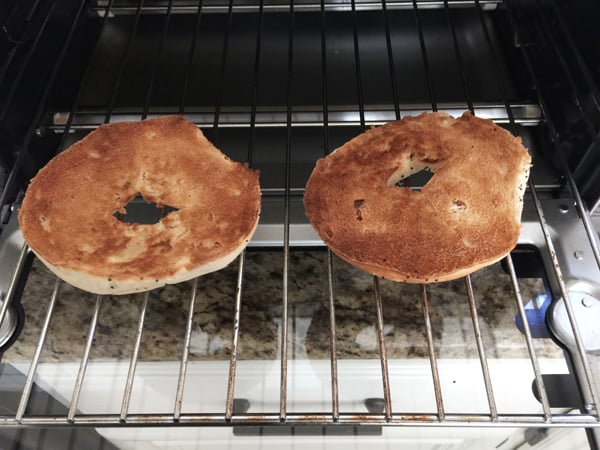
Does the Oven Type Change Toasting Time?
Yes. Your oven can make a noticeable difference in how quickly a bagel becomes crisp.
A conventional oven provides fairly steady heat from the top and bottom. A convection oven circulates hot air, which can toast food faster. Toaster ovens are smaller and can also heat the bagel more quickly.
If you’re using a convection oven, try 350°F for about 2 to 4 minutes. Check early because some convection ovens brown food very quickly.
If you’re using a toaster oven, 2 to 3 minutes at 375°F may be enough for a fresh bagel.
The first batch is the best way to learn how your particular oven behaves.
What Temperature Is Best for Toasting Bagels?
For most bagels, 375°F is a good oven temperature.
It gives the cut surface enough heat to become crisp and golden without requiring extremely high heat. If you prefer a slower, gentler toast, you can use 325°F to 350°F and allow more time.
For faster browning, you can use 400°F to 425°F, but watch the bagel closely. At higher temperatures, the edges and toppings can brown very quickly.
The basic rule is simple:
Higher temperature = faster browning.
Lower temperature = slower, gentler toasting.
I recommend starting at 375°F because it gives you a useful middle ground between crispness and even heating.
:max_bytes(150000):strip_icc()/__opt__aboutcom__coeus__resources__content_migration__serious_eats__seriouseats.com__images__2015__09__20150822-toast-whole-bagel-5-58b1171f25234c40bec9915f118ddd20.jpg)
If you want to learn about the Temperature of Pork Cooking, read the What Temperature Should Pork Be Cooked To: Safe Temp Tips
How to Toast a Bagel in the Oven
You don’t need special equipment to make a good oven-toasted bagel. Follow these simple steps.
1. Preheat the Oven
Set your oven to 375°F and let it fully preheat.
A properly preheated oven gives you more predictable results than putting the bagel into a cold oven.
2. Slice the Bagel
Cut the bagel in half horizontally if it isn’t already sliced.
Try to make the two halves as even as possible so they toast at about the same rate.
3. Place the Bagel Cut-Side Up
Place both halves on a baking sheet with the cut side facing up.
This exposes the flat surface directly to the heat and helps it develop the crisp texture most people want from a toasted bagel.
4. Start With 3 Minutes
Put the bagel into the preheated oven and set a timer for 3 minutes.
Don’t walk away for too long. Bagels can go from lightly toasted to overly brown faster than you might expect.
5. Check the Color and Texture
At 3 minutes, check the cut surface.
If it is lightly golden with crisp edges, you can take it out. If it still looks pale, toast it for another 1 to 2 minutes.
6. Let It Cool Briefly
Give the toasted bagel about 30 seconds to a minute before adding your toppings.
This short rest makes it easier to spread butter, cream cheese, or other toppings without them immediately sliding across the hot surface.
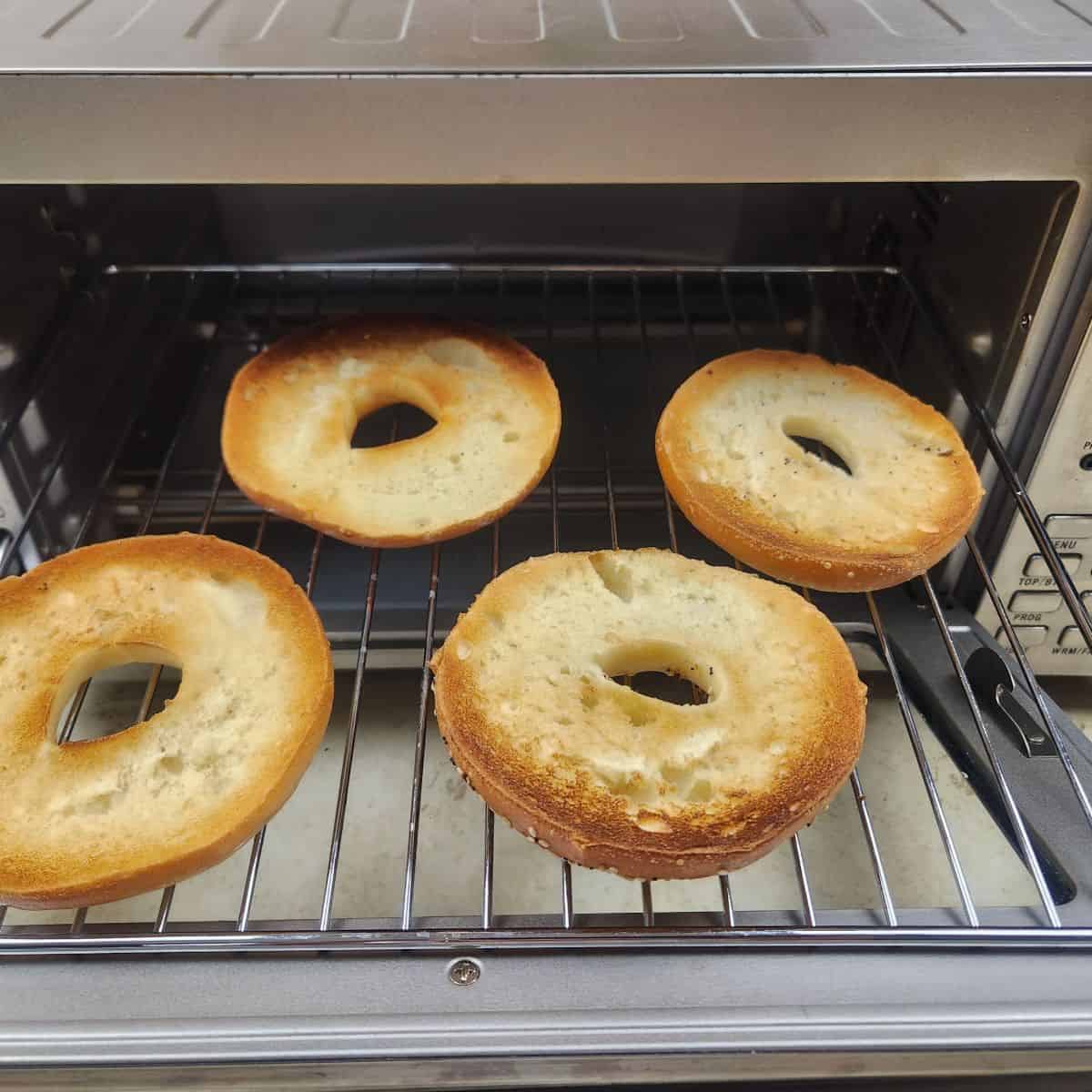
How Long to Toast a Frozen Bagel in the Oven
You can toast a frozen bagel directly from the freezer.
At 375°F, a frozen bagel usually takes around 5 to 7 minutes. The extra time allows the center to warm while the cut surface becomes crisp.
For more even results, you can also let the frozen bagel sit at room temperature for about 10 to 15 minutes before toasting. After that, start with approximately 3 to 4 minutes in the oven.
If you’re in a hurry, I prefer putting the frozen bagel directly into the oven and checking it during the final few minutes.
How Long to Toast a Day-Old Bagel
Day-old bagels have less moisture than fresh bagels, so their texture can change during toasting.
A good starting point is 4 to 6 minutes at 375°F.
Check the bagel after 4 minutes. If it already looks deeply golden, remove it. If it still needs more color, give it another minute or two.
For a very dry bagel, be careful not to over-toast it because it can become hard and crunchy throughout.
How Long to Toast a Thick Bagel?
Thick, dense bakery-style bagels usually need more time than thin supermarket bagels.
For a large or dense bagel, start with 6 to 8 minutes at 375°F and check it regularly.
A thick bagel can become nicely browned on the outside while still being cooler in the center. Giving it a little more time at a moderate temperature can help warm the inside without immediately burning the crust.
What About Everything, Seeded, and Whole Wheat Bagels?
Bagel toppings can affect how quickly the surface browns.
Everything bagels and seeded varieties may develop dark spots faster because of the seeds and seasonings on the surface. Whole wheat bagels can also brown differently from plain bagels.
For these varieties, start checking about 1 minute earlier than you normally would.
If the seeds are getting too dark before the bagel is warm enough, lower the oven temperature slightly and give the bagel more time.
Should a Bagel Go Cut-Side Up or Down?
For oven toasting, I recommend placing the cut side up.
The flat cut surface gets direct heat, which helps it become crisp and golden. The rounded outside receives gentler heat.
This setup gives you the classic combination of a crunchy toasted surface and a warm interior.
If you put the cut side down, the flat surface won’t receive the same direct heat, so you may not get the crisp texture you’re looking for.
Why Is My Bagel Burnt Outside but Cold Inside?
If the outside is dark while the center is still cold, your oven may be too hot or the bagel may be too close to the heating element.
Try these adjustments:
- Lower the temperature by about 25°F.
- Move the oven rack to the center position.
- Increase the cooking time slightly.
- Check the bagel earlier during the next batch.
- Use an oven thermometer if your oven temperature seems inconsistent.
A lower temperature with a little more time can help heat the bagel more evenly.

Why Is My Bagel Crispy but Still Cold Inside?
This usually means the bagel needs more time.
Instead of increasing the temperature dramatically, try adding 1 to 2 minutes to the cooking time.
For thick bagels, you may need considerably longer than the standard 3 to 5 minutes. A thick bakery bagel can take around 6 to 8 minutes.
Why Does One Side Toast Faster Than the Other?
Uneven browning can happen because of hot spots inside your oven.
If one side of the bagel consistently gets darker, rotate the baking sheet halfway through cooking. You can also try a different oven rack position.
An inexpensive oven thermometer can also help if you suspect the temperature displayed by your oven isn’t accurate.
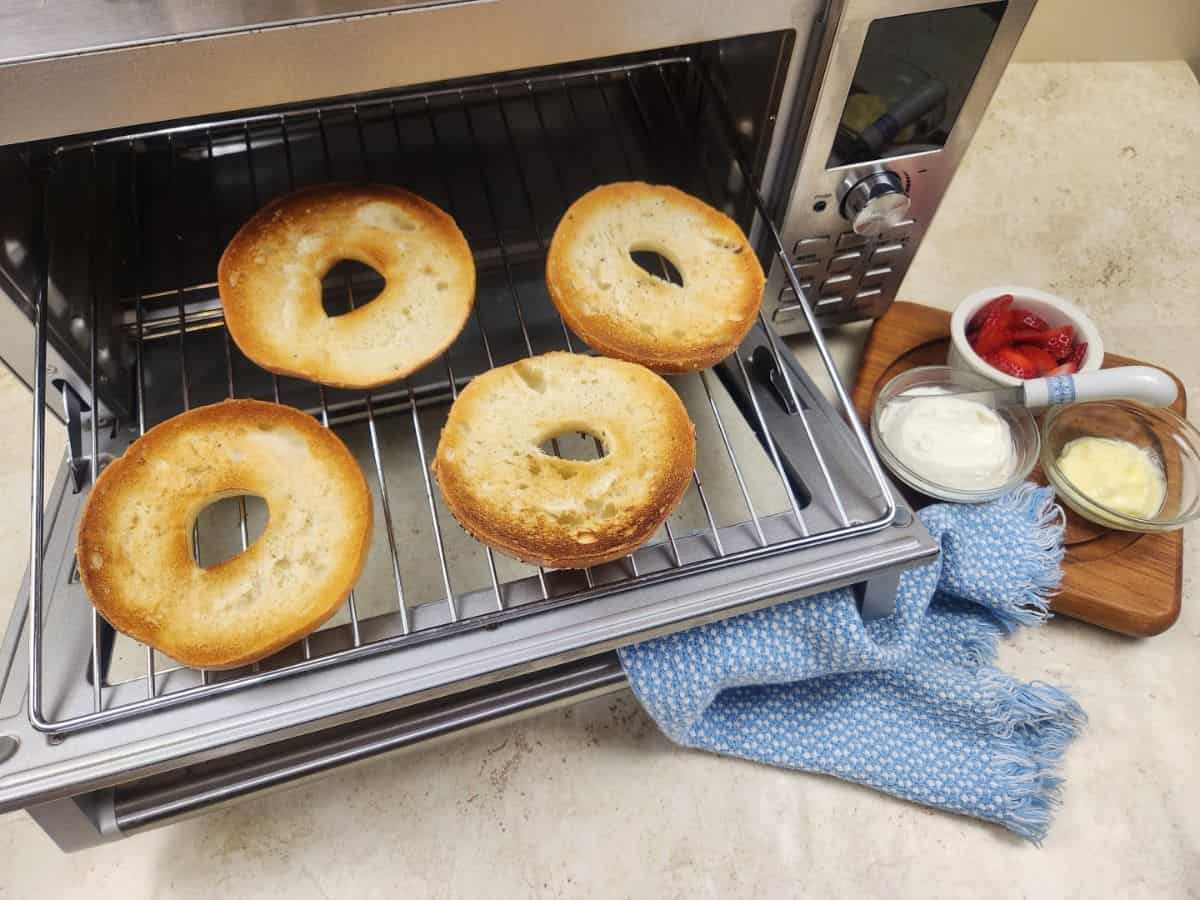
How to Toast Multiple Bagels at Once
If you’re preparing breakfast for several people, you can toast multiple bagel halves in one batch.
Avoid overcrowding the baking sheet. Leave enough space between the halves so heat can circulate around them.
For a standard oven, four bagel halves can usually be arranged comfortably without crowding. If you’re making more than that, consider using two batches rather than stacking or tightly packing the bagels.
Once you know how quickly your first batch browns, the next batch should be easier to time.
For busy mornings, slice all of your bagels while the oven preheats and have your toppings ready. That way, you can serve each bagel while it is still warm and crisp.

Can You Toast a Bagel Without a Toaster?
Absolutely. An oven is a simple alternative when you don’t have a toaster or when you’re preparing several bagels at once.
A toaster or toaster oven is usually quicker for one bagel, but an oven gives you more control over the temperature and lets you toast several halves together.
You can also use a skillet or broiler, depending on the texture you want.
Skillet Method
Heat a skillet over medium heat and place the bagel halves cut-side down.
Toast for around 3 to 4 minutes, checking frequently to prevent burning. This method can produce a very crisp surface and is useful when your oven is occupied.
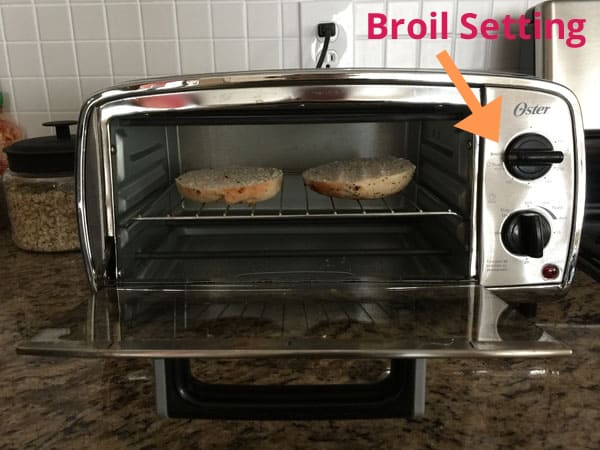
Broiler Method
A broiler works much faster because it uses intense direct heat.
Place the bagel cut-side up on a baking sheet and position it several inches below the broiler. Start with 1 to 2 minutes, but watch it continuously.
Broilers can burn a bagel very quickly, especially when it has seeds or toppings.
Toaster or Toaster Oven
If you’re only making one or two bagels, a toaster or toaster oven is usually the fastest option.
A toaster oven can also be useful if you want to avoid heating a full-size oven for a small breakfast.
My Simple Bagel Toasting Formula
If you don’t want to remember all the different times, start with this:
Fresh bagel + conventional oven + 375°F = 3 to 5 minutes
That’s the baseline I recommend.
From there, adjust based on what you’re cooking:
- Want it lighter? Check around 3 minutes.
- Want it darker? Add 1 to 2 minutes.
- Using a thick bagel? Give it more time.
- Using a frozen bagel? Start around 5 to 7 minutes.
- Using convection? Try 350°F for 2 to 4 minutes.
- Using a seeded bagel? Check it early.
Once you find the timing that works for your oven and favorite bagel, you can repeat it almost every time.
Frequently Asked Questions
How long should I toast a bagel in the oven at 375°F?
For a fresh bagel, toast the sliced halves for about 3 to 5 minutes at 375°F. Start checking at 3 minutes and add more time if you want a darker, crunchier surface.
Can I toast a frozen bagel without thawing it?
Yes. A frozen bagel can go directly into a preheated 375°F oven. Allow approximately 5 to 7 minutes, depending on its size and thickness.
What is the best oven temperature for bagels?
375°F is a good starting temperature for most bagels. It provides enough heat for a crisp exterior while allowing the inside to warm without excessive browning.
Should I toast a bagel cut-side up?
Yes. Place the bagel cut-side up when oven toasting. This exposes the flat surface to direct heat and helps create a crisp, golden texture.
Why does my bagel burn before it gets warm inside?
Your oven may be too hot, or the bagel may be too close to the heating element. Lower the temperature by about 25°F, move the rack toward the center, and allow the bagel to toast for a little longer.
How long does a thick bagel take to toast?
A thick, dense bagel can take around 6 to 8 minutes at 375°F. Start checking before the end of that range because ovens and bagel sizes vary.
Can I toast bagels in a convection oven?
Yes. Because convection ovens circulate hot air, you can start around 350°F for 2 to 4 minutes. Check early and adjust according to how quickly your oven browns the bagel.
How do I stop my bagel from becoming too dry?
Avoid leaving it in the oven longer than necessary. Start checking at the lower end of the recommended time and remove it once the cut surface reaches your preferred color and crispness.
Is an oven better than a toaster for bagels?
It depends on your needs. A toaster is usually faster for one bagel, while an oven is useful when you’re making several bagels or want more control over the temperature and browning.
Final Thoughts: The Best Way to Toast a Bagel in the Oven
So, how long to toast a bagel in the oven? For most fresh bagels, start with 3 to 5 minutes at 375°F.
That’s the easiest baseline to remember. From there, adjust the time for frozen, thick, day-old, seeded, or unusually thin bagels.
The most important thing is to start checking early. Every oven heats a little differently, and every bagel has a different size, thickness, and moisture level.
If your first batch isn’t perfect, don’t worry. Make a small adjustment to the time or temperature and try again. After a few batches, you’ll know exactly how your oven toasts your favorite bagel.
For a quick morning breakfast, my go-to method is simple: preheat to 375°F, place the sliced bagel cut-side up, toast for 3 minutes, check it, and add another 1 to 2 minutes if needed.
That’s all it takes to turn a plain bagel into a warm, golden, crispy breakfast.