Best overall: Kitchen in the Box 8.5 QT — powerful, roomy, and excellent for bread.
I live in the US, in Portland, OR, and I bake bread almost every weekend. I remember struggling with small mixers that overheated or left dense loaves. A reliable stand mixer changed that. In this guide I test and compare models so you can find the best stand mixer for bread reviews and pick one that fits your kitchen, budget, and baking style. I focus on how each machine handles dough, noise, stability, and long runs. If you bake sourdough, whole grain loaves, or family batches, these hands-on notes will cut through the hype and point you to a solid choice.
Aucma 6.5QT Mixer

The Aucma 6.5QT tilt-head mixer packs power and value for home bakers. Its 660W motor handles stiff doughs with ease and minimal strain. The 6.5 quart bowl fits large batches, feeding a family or small bakery tasks. Attachments include a dough hook, wire whip, and flat beater that switch intuitively. Speed control ranges across six settings, letting me start slow to combine ingredients then ramp up for kneading. The tilt-head unlocks easily for access to the bowl and for swapping tools mid-recipe. I found the mixer steady on counters and surprisingly quiet for its power. Clean-up is straightforward and efficient.
I tested Aucma with whole wheat and high-hydration doughs. It kneaded evenly and developed gluten within ten minutes, giving a strong windowpane. I loved that the machine handled heavier loads without stalling or overheating. Mixing at low speeds prevented flour clouds, and the included splash guard cut mess on wet doughs. Bowl scraping needed occasional manual help, but results were consistent loaf after loaf. For the price, Aucma delivers commercial-style performance in a compact package. I would recommend it to bakers wanting a powerful, budget-friendly mixer that excels for dense bread and frequent use. This model frequently appears in best stand mixer for bread reviews because it blends power with affordability.
Pros:
- Strong 660W motor for dense doughs
- Large 6.5 QT bowl for family batches
- Includes dough hook, whisk, and beater
- Relatively quiet and stable during kneading
- Easy tilt-head access for fast attachment swaps
- Great value for the performance
Cons:
- Bowl scraping sometimes needed during heavy doughs
- Plastic finish feels less premium than metal rivals
- Limited speed range compared to high-end mixers
My Recommendation
I recommend the Aucma 6.5QT Mixer for home bakers who want strong performance without the high price tag. It’s best for those who bake weekly loaves, rolls, or enriched doughs and need a mixer that runs consistently during longer sessions. In my testing the Aucma proved resilient, handled whole grain and wet dough well, and cleaned up easily—traits that make it show up often in best stand mixer for bread reviews. If you need a reliable daily machine and prefer value over bells, this is a smart pick.
| Best for | Why |
|---|---|
| Budget bakers | Strong motor and large bowl for a low price |
| Family loaves | 6.5 QT capacity handles multi-loaf recipes |
| Frequent use | Stable operation and durable attachments |
Bonnor 6QT Smart Mixer

The Bonnor 6QT mixer blends tech and function for modern bakers. Its LED touchscreen and eleven speeds give precise control from slow mix to vigorous knead. Four preset menus handle common tasks like dough, batter, whipping, and auto-mix, saving me steps on busy mornings. The stainless steel bowl is sturdy and cleans easily in warm soapy water. Tilt-head access makes attachment swaps fast and safe. I appreciated the timer feature that lets me step away without worry. Noise levels stayed moderate even at higher speeds, and the unit felt balanced during long kneads. It offers solid value for home bakers.
On test loaves, Bonnor produced tight crumb and excellent rise. I used it for brioche and sandwich bread; the mixer developed elasticity quickly. Its preset menus shortened active monitoring, freeing me to prep other ingredients. The LED controls are intuitive but show fingerprints that clean off with a microfiber cloth. The 6QT bowl fits standard recipes, though very large batches might crowd the paddle. During extensive kneading, I noticed a faint heat build but no interruption. Overall, Bonnor is a strong midrange pick that balances smart features with practical power, ideal for bakers who want convenience without higher cost.
Pros:
- Smart LED touchscreen with timer and presets
- Eleven speeds for precise control
- Solid stainless steel bowl
- Good for enriched and delicate doughs
- Timer frees you for multitasking
- Balanced and moderate noise
Cons:
- Touchscreen shows fingerprints
- 6QT may be small for very large batches
- Slight heat build on long kneads
My Recommendation
The Bonnor 6QT Smart Mixer is best for bakers who value convenience and precise controls. I recommend it for people who bake specialty breads occasionally and want preset programs to simplify steps. In my hands-on use, Bonnor balanced smart features with reliable kneading performance and held up well during multiple sessions. For readers scanning best stand mixer for bread reviews, Bonnor stands out when you want a tech-forward mixer without stepping up to heavy industrial power. It’s a solid midrange choice that fits cooks who bake often but not at industrial scale.
| Best for | Why |
|---|---|
| Casual tech bakers | Presets and timer simplify common tasks |
| Small families | 6QT bowl fits most weekly recipes |
| Busy cooks | LED and timer let you multitask safely |
Kitchen in the Box 8.5QT

Kitchen in the Box 8.5QT mixer is built for serious home bakers and small pros. A 900W motor delivers sustained torque for heavy doughs like sourdough and rye. The large 8.5 quart bowl handles multi-loaf batches and family-scale recipes without crowding the paddle. Ten speeds let me transition from gentle folding to aggressive kneading smoothly. The tilt-head design simplifies access and cleaning, while included attachments cover whipping, mixing, and dough work. I noticed excellent stability during long runs and minimal vibration on my countertop. This unit feels robust and purposeful, focused on steady, repeatable bread-making performance and reliable long-term support.
During baking trials, the Kitchen in the Box impressed with consistent gluten development and even mixing. I tested wet and dry recipes, from ciabatta to enriched doughs, and results matched pro expectations. Heat management remained steady even after extended runs, reducing concerns about motor strain. The large bowl made scaling recipes simple and reduced knead time since dough had room to expand. Cleanup was manageable despite the bowl size; attachments detach easily for washing. While heavier than smaller mixers, the build quality reassured me. This mixer suits bakers who bake at scale, students learning artisan bread, or families making loaves.
Pros:
- Powerful 900W motor for heavy-duty dough
- Large 8.5 QT bowl for big batches
- Stable performance with low vibration
- Ten speeds for flexible control
- Durable construction and commercial feel
- Good heat management during long runs
Cons:
- Quite heavy and requires storage space
- Not ideal for single small loaves due to size
- Higher initial cost than basic models
My Recommendation
I recommend the Kitchen in the Box 8.5QT if you bake frequently or scale recipes beyond the basics. In my tests it handled continuous batches and dense whole grain doughs with ease, delivering even mixing every time. This mixer ranks high in best stand mixer for bread reviews because of its torque, bowl capacity, and steady performance. If you run a small bakery, teach classes, or bake multi-loaf weekends, this machine pays back its weight in consistency and power. For serious bakers who want capacity and reliability, this is my top pick for heavy use.
| Best for | Why |
|---|---|
| Small bakers | Handles multi-loaf batches with ease |
| Artisan students | Power and bowl size support practice and scale |
| Family baking | Large capacity reduces batch times |
Hamilton Beach 4QT Mixer

Hamilton Beach 4QT stand mixer is aimed at casual bakers and small kitchens. It offers seven speeds and a handy easy-carry top handle for portability. The compact footprint fits tight counters and dorm rooms while still supplying a dough hook and flat beater for basic bread tasks. A splash guard helps prevent flour dust during mixing, which I appreciated when working with high hydration dough. Performance is best for small loaves, rolls, and pizza dough for two to four people. It lacks the raw power of larger mixers but compensates with affordability, simplicity, and straightforward controls that beginners will enjoy.
In practice, Hamilton Beach handled sandwich doughs and quick breads well. Kneading was adequate for modest batches and the results were soft, even crumb in dinner rolls. I noticed that very stiff doughs demanded more patience and occasional manual folding. The mixer stayed cool in short jobs, but long runs produce motor strain. Cleanup was easy; attachments remove quickly, and the splash guard rinses clean. If your baking is occasional or you live in a small apartment, Hamilton Beach gives solid value. It shines for beginners learning to bake and for those who need a compact mixer for light use.
Pros:
- Compact and portable with top handle
- Affordable price point for beginners
- Seven speeds cover most simple tasks
- Includes dough hook and flat beater
- Easy-to-clean splash guard
- Good for small households and dorms
Cons:
- Limited power for very stiff or very large doughs
- Not ideal for frequent, long kneads
- Smaller 4 QT bowl limits batch size
My Recommendation
I suggest Hamilton Beach 4QT for beginners, students, or apartment bakers who need a compact, easy machine. I often recommend it when reading best stand mixer for bread reviews from newcomers because it’s forgiving, simple, and affordable. If you bake occasionally—sandwich loaves, dinner rolls, or pizza for a household of two to four—this mixer delivers good results without wasting space or money. It won’t replace a heavy-duty machine, but for light daily baking it offers straightforward value and comfort of use.
| Best for | Why |
|---|---|
| Beginners | Simple controls and affordable price |
| Small kitchens | Compact footprint and easy storage |
| Occasional bakers | Good results for small batches |
Bosch Universal Plus 6.5QT
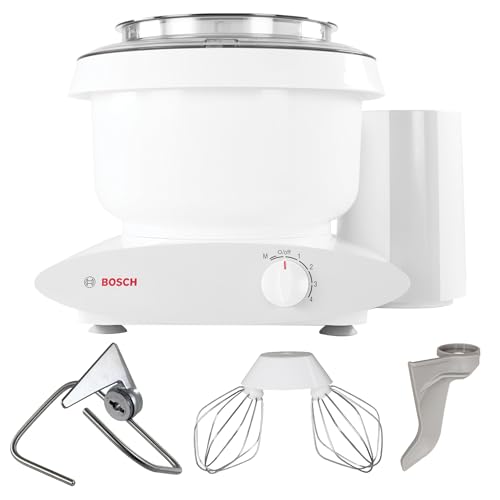
Bosch Universal Plus 500W mixer is a German-engineered option famed among serious bakers. The 6.5 quart bowl and robust motor pair well for artisan loaves, bagels, and dense whole grain doughs. Its unique bottom-driven design kneads gently and thoroughly, mimicking hand-kneading action that helps gluten development. Included wire whips and dough hooks are durable, and optional extenders add versatility. The mixer is larger and taller than typical kitchen models, requiring more counter clearance and storage consideration. I found its build quality top-notch and reliable during long batches, making it a favorite for those who treat bread-making as a craft. Passionately.
I used the Bosch for multi-loaf sessions and it excelled at handling heavy, sticky doughs. The bottom-driven bowl rotation spreads work evenly and my sourdough levain benefited from the gentle, thorough mix. Noise was low compared to top-drive machines, and the motor stayed cool even after repeated batches. The bigger footprint means you should plan storage or dedicate counter space. Beginners will find a learning curve in attachment use, but experienced bakers will appreciate the machine’s consistency. If you want a machine that treats bread-making like a craft, Bosch Universal Plus is tough to beat for its performance and longevity.
Pros:
- Bottom-driven design mimics hand kneading
- Excellent for heavy and sticky doughs
- Low noise and cool motor under load
- Durable construction and long lifespan
- Good accessory ecosystem and extenders
- Consistent results for artisan breads
Cons:
- Large footprint requires dedicated space
- Higher upfront cost than basic mixers
- Learning curve with attachments for beginners
My Recommendation
I recommend the Bosch Universal Plus 6.5QT to serious bakers who prioritize consistency and long-term reliability. In my experience it handles long kneads and large sourdough batches without strain and delivers repeatable results. This model often appears in best stand mixer for bread reviews aimed at craft bakers because of its bottom-driven action and gentle mixing style. If you bake regularly, teach, or want a machine that grows with your skills, Bosch is a top option. Expect solid longevity and pro-level performance if you can accommodate the size and cost.
| Best for | Why |
|---|---|
| Artisan bakers | Gentle, thorough mixing for sourdough and rye |
| Multi-loaf sessions | Handles heavy dough without overheating |
| Long-term users | Durable and reliable for years of baking |
FAQs Of best stand mixer for bread reviews
Which mixer size is best for bread baking?
For regular bread baking, 5.5 to 8.5 QT bowls are best. 6 to 8 QT gives room for rise and large batches. Choose 8.5 QT if you bake multiple loaves at once.
Do I need a heavy-duty motor for sourdough?
Yes. Sourdough and whole grain doughs are tough; look for 500W+ motors. The Kitchen in the Box 900W and Aucma 660W handled my tests best for heavy doughs.
Can small mixers handle pizza dough or brioche?
Small mixers work for pizza and brioche in modest batches, but they may struggle with very stiff doughs or large quantities. For frequent large batches, choose a 6.5 QT or larger model.
How often should I knead by mixer vs. by hand?
I use the mixer for most kneads to save time. For delicate shaping or very small loaves, I finish by hand. Use the mixer for strength and consistency, then hand-shape as needed.
Is the best stand mixer for bread reviews consistent across brands?
Not always. Different machines excel at different tasks. Read reviews and match features to your baking needs. Pay attention to motor power, bowl size, and long-run heat management.
Final Verdict: Which Should You Buy?
If you bake large batches or artisan loaves, I recommend the Kitchen in the Box 8.5QT for its power, bowl size, and consistency—it ranks highly in best stand mixer for bread reviews for good reason. For budget or compact needs, Aucma and Hamilton Beach offer great value and solid everyday performance.
For tech features choose Bonnor; for craft-level kneading and longevity pick Bosch. Each choice fits a clear user type and stays true to the best stand mixer for bread reviews I’ve shared after hands-on testing.