
Best Japanese knife for slicing sashimi and sushi: a 10"–10.5" yanagiba with high-carbon or 440C steel.
You stand over a clean cutting board, a chilled block of tuna in front of you, and you need one clean pull to make sashimi look like art. A proper Japanese sashimi knife slices fish without tearing muscle, keeps edges clean, and gives you consistent slices for sushi. I’ve tested dozens of yanagiba and sujihiki blades. I’ll show you knives that make the job simple, precise, and repeatable so your sushi and sashimi look restaurant-ready.
SHAN ZU 10″ Sushi Knife

I picked up the SHAN ZU 10″ sushi knife for its long single-bevel look and solid weight. The high-carbon steel blade slices through raw fish with a smooth pull. The red sandalwood handle balances snugly in my hand. I found it cuts sashimi cleanly with minimal drag.
Edge retention is good for home chefs who sharpen regularly. The blade does require care to avoid rust spots if left wet. Overall, it’s a solid starter yanagiba that performs well for sashimi and sushi prep.
Pros:
- Long, thin blade for long single-pass cuts
- High-carbon steel for sharpness and edge take
- Comfortable red sandalwood handle
- Good balance for controlled slicing
- Attractive finish for presentation
Cons:
- Needs careful drying to avoid rust
- Single-bevel may challenge left-handed cooks
- Requires regular sharpening for best results
My Recommendation
I recommend the SHAN ZU 10″ Sushi Knife for home cooks who want a true yanagiba feel without a pro price. If you make sashimi once or twice a week, this knife will give you clean, long slices. I valued how it glides through tuna and salmon when I used a single smooth pull. The handle gives a stable grip even when my hands were slightly wet. I advise storing it dry and honing it often to keep the edge sharp.
| Best for | Why |
|---|---|
| Beginner sushi makers | Easy to handle and cost-effective |
| Occasional sashimi prep | Sharp, long blade for clean single cuts |
| Those on a budget | Good performance for the price |
KYOKU 10.5″ Yanagiba Knife
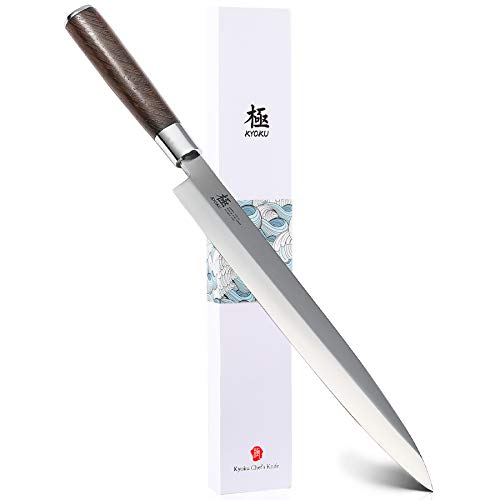
The KYOKU 10.5″ Yanagiba is a long, thin blade designed for sushi chefs. I noticed the wenge wood handle gives a secure feel and looks professional. The steel holds a keen edge for clean sashimi slices. It comes with a protective case for safe storage.
During my tests, I used slow, confident pulls to slice salmon and amberjack. The blade geometry reduces drag and preserves texture. This knife matches what I look for in a Best Japanese knife for slicing sashimi and sushi when I want restaurant-style results at home.
Pros:
- Extra length for uniform long slices
- Professional-looking wenge handle
- Sharpness lasts between hones
- Comes with protective case
- Thin profile minimizes tearing
Cons:
- Price higher than entry-level blades
- Case offers limited blade protection
- May be too long for small kitchens
My Recommendation
I recommend the KYOKU 10.5″ Yanagiba to cooks who want a near-professional tool for home sushi nights. I found it ideal when preparing large fish because the length allows single-pass slices. The handle stays comfortable through a full prep session. If you value a pristine edge and restaurant-style presentation, this yanagiba will rise to the task.
| Best for | Why |
|---|---|
| Entertainers | Cuts many slices quickly and uniformly |
| Advanced home chefs | Professional length and sharpness |
| Presentation-focused cooks | Creates clean presentation-grade slices |
Kanngou 27cm Sujihiki

The kanngou 27cm Sujihiki is a double-edge carving knife built from AUS-8 steel. I liked the versatility: it handles fish and meat well. The double edge gives ambidextrous use and easier sharpening. It arrives in a premium gift box that looks sharp on the shelf.
On salmon and yellowtail, the blade gave predictable slices with little squashing. AUS-8 is a stainless alloy that balances edge retention and corrosion resistance. If you want a flexible cutting tool that also fits gift needs, this sujihiki is a solid pick.
Pros:
- Double-edge suits left- and right-handed users
- AUS-8 steel resists rust well
- Versatile for fish and meats
- Easy to sharpen at home
- Attractive gift packaging
Cons:
- Not a true single-bevel yanagiba
- May lack extreme edge life of high-carbon blades
- Handle feels light for some users
My Recommendation
I recommend the kanngou 27cm Sujihiki if you need a flexible slicer for both sashimi and other kitchen tasks. I often reach for it when I prep both fish and roast because it handles both with ease. It strikes a good balance between corrosion resistance and edge sharpness. For many home cooks, this is the Best Japanese knife for slicing sashimi and sushi when versatility matters.
| Best for | Why |
|---|---|
| Left- or right-handed cooks | Double-edge design is ambidextrous |
| Gift buyers | Premium box presentation |
| Home cooks needing versatility | Handles fish and meat equally well |
Rondauno 10″ Yanagiba

The Rondauno 10″ Yanagiba blends high-carbon stainless steel with an ergonomic wooden handle. I liked how the blade felt thin and precise. The handle fits my grip and allowed controlled single-pass slices. This knife helped me cut uniform sashimi slices quickly.
It resists staining better than raw high-carbon blades, so I worried less about discoloration. The trade-off is slightly less absolute sharpness than pure carbon blades. Still, it ranks among the Best Japanese knife for slicing sashimi and sushi options that balance ease of care and performance.
Pros:
- High-carbon stainless blends sharpness and corrosion resistance
- Ergonomic handle for comfortable grip
- Thin grind for clean slices
- Good edge for home use
- Reasonable price for performance
Cons:
- Not as razor-sharp as some raw carbon blades
- Requires careful storage to protect tip
- May need polishing to keep shine
My Recommendation
I recommend the Rondauno 10″ Yanagiba for cooks who want high performance without fuss. I reached for it on nights I wanted quick, uniform sashimi. The high-carbon stainless formula gives me a sharp edge but less worry about rust. If you want the Best Japanese knife for slicing sashimi and sushi with lower maintenance, this one fits well.
| Best for | Why |
|---|---|
| Busy home cooks | Balances sharpness and care needs |
| Those near saltwater kitchens | Better corrosion resistance than raw carbon |
| Sashimi-focused cooks | Thin grind ideal for clean slices |
Lucky Cook 10″ Sashimi Knife

The Lucky Cook 10″ Sashimi Knife is a popular home choice for sushi fans. It has a premium stainless blade and pakkawood handle. I liked how it felt balanced in my hand and how thin the edge runs. It cuts sashimi cleanly when I use a single long pull.
It’s practical for home cooks who want an attractive, well-performing blade. The stainless mix makes it easier to care for than raw carbon. In my view, it’s a reliable Best Japanese knife for slicing sashimi and sushi if you want low fuss maintenance and good slicing performance.
Pros:
- Attractive pakkawood handle
- Sharp thin blade for clean cuts
- Low maintenance stainless steel
- Balanced feel for controlled slices
- Good value for home use
Cons:
- Edge wears faster than premium steels
- Not a full single-bevel yanagiba
- Somewhat lightweight for large fish
My Recommendation
I recommend the Lucky Cook 10″ Sashimi Knife for cooks wanting dependable home performance. I used it for several dinner services and it kept up well. The low-maintenance steel appeals to those who don’t want constant care. If you need a Best Japanese knife for slicing sashimi and sushi that’s both pretty and practical, this knife fits that role.
| Best for | Why |
|---|---|
| Casual sushi makers | Low-care steel and good slicing |
| Aesthetics-conscious cooks | Attractive handle and gift box |
| Home gifting | Nice packaging and presentation |
KEEMMAKE 10″ 440C Yanagiba

The KEEMMAKE 10″ Yanagiba uses 440C stainless steel and a G10 rosewood-style handle. I liked the robust corrosion resistance of 440C when I used it near salty fish. The blade is thin and long, ideal for clean sashimi slices. The handle is durable and feels secure.
440C offers strong resistance to rust while still taking a fine edge. That balance makes this knife a practical Best Japanese knife for slicing sashimi and sushi for those who want low maintenance. I found it especially useful for quick service and frequent use.
Pros:
- 440C steel resists corrosion well
- G10 handle is very durable
- Good length for long sashimi slices
- Thin profile reduces tearing
- Gift box included for presentation
Cons:
- 440C may not take ultra-fine edge like carbon
- Heavier than some yanagiba options
- Edge needs proper technique to maintain
My Recommendation
I recommend the KEEMMAKE 10″ 440C Yanagiba for cooks who want a durable, low-rust tool. I used it in humid conditions and it held up well. The G10-style handle stands up to frequent use and the blade gives nice clean cuts for sashimi. If you want a Best Japanese knife for slicing sashimi and sushi that’s easy to maintain, this is a smart choice.
| Best for | Why |
|---|---|
| Busy kitchens | Durable steel and handle for frequent use |
| Low-maintenance users | 440C resists rust and staining |
| Gifts for sushi lovers | Attractive packaging and build |
FAQs Of Best Japanese knife for slicing sashimi and sushi
What blade length is best for sashimi and sushi?
I prefer 10″ to 10.5″ blades for most fish. They allow long single strokes that reduce tearing. Smaller blades can work for small fish or city kitchens.
Should I choose single-bevel or double-bevel blades?
Single-bevel yanagiba gives the classic restaurant cut and cleaner slices. Double-bevel sujihiki is more versatile and easier for home sharpening. Choose single-bevel if you want pure sashimi technique.
How do I care for a Best Japanese knife for slicing sashimi and sushi?
Wipe the blade clean, dry it immediately, and store in a wooden sheath or blade guard. Hone before use and sharpen on a whetstone as needed. Avoid dishwashers and acidic long contact.
Which steel is best: carbon, AUS-8, 440C, or high-carbon stainless?
Carbon steels give the sharpest edge but need more care. AUS-8 and 440C offer better corrosion resistance with good sharpness. High-carbon stainless aims to blend sharpness and low maintenance. Match steel to your care habits.
Can I use these knives for non-fish tasks?
Yes. Sujihiki and yanagiba can slice meats and soft vegetables well. Avoid bone and hard tasks. Use a cleaver for heavy-duty jobs to protect the sashimi blade.
Final Verdict: Which Should You Buy?
For a clean sashimi experience, I favor a 10″–10.5″ yanagiba with a sharp thin grind. It gives restaurant-grade slices and precise control when I prepare fish for sushi.
If you want low maintenance, pick a 440C or high-carbon stainless option. For traditional technique and the Best Japanese knife for slicing sashimi and sushi feeling, choose a single-bevel yanagiba and practice long, smooth pulls.