
A good kitchen rug should do more than make your kitchen look better. It should stay in place, protect your hardwood floor from everyday spills, feel comfortable under your feet, and be easy to clean when cooking gets messy.
The best kitchen rugs for hardwood floors combine non-slip grip, low-profile construction, easy maintenance, and enough cushioning for standing near the sink or counter. Washable options are especially useful because kitchens see more food, grease, water, and foot traffic than most rooms.
For this guide, I compared five popular options across comfort, grip, floor protection, washability, thickness, style, and everyday practicality. I also looked at the features that matter most for hardwood, including backing materials, moisture protection, and the risk of trapped dirt or water.
Our Top Picks
| Kitchen Rug | Best For | Main Strength | Profile | Washability | Our Rating |
|---|---|---|---|---|---|
| SUMLANS Kitchen Mat Set | Budget buyers | Comfort and value | Low/medium | Machine washable* | 9.2/10 |
| HEBE Boho Kitchen Rug Set | Style | Decorative 3-piece coverage | Low | Machine washable* | 9.0/10 |
| KMAT Kitchen Mat 2-Piece Set | Anti-fatigue comfort | Cushioning and water resistance | Medium | Easy-clean surface | 9.4/10 |
| eqivei Kitchen Rugs | Minimalist kitchens | Thin, discreet design | Low | Machine washable* | 8.9/10 |
| Pauwer Kitchen Mats 3-Piece Set | Farmhouse style | Comfort and coverage | Medium | Washable* | 9.1/10 |
Always follow the current manufacturer’s care instructions before washing or drying a rug.
1. SUMLANS Kitchen Mat Set (2 PCS)

The SUMLANS 2-piece kitchen mat set is a strong choice if you want comfortable coverage without spending much. A two-piece configuration is particularly useful because you can place one mat in front of the sink and another near a prep area, stove, or island.
Available product information lists the set at approximately 17.3 × 47 inches and 17.3 × 30 inches, with a polyester surface and rubber non-slip backing.
Why I Like the SUMLANS Set
The biggest advantage is its balance of comfort, grip, and convenience.
A cushioned kitchen rug can make a noticeable difference when you spend a long time washing dishes, preparing meals, or standing at a counter. The SUMLANS set is better suited to those situations than an extremely thin decorative rug.
Its non-slip backing is also useful on smooth sealed hardwood. However, no rug should be assumed to be safe for every hardwood finish. Before placing any backed rug on a newly refinished or particularly delicate floor, test it in an inconspicuous area and check the manufacturer’s recommendations.
The polyester surface is practical for a busy kitchen because it can be cleaned more easily than many traditional decorative rugs. The low-to-moderate profile also makes it more practical around cabinet doors than a very thick area rug.
Pros
- Two-piece configuration covers multiple kitchen zones
- Cushioned feel is comfortable for standing
- Non-slip backing helps reduce movement
- Machine washable according to available product information
- Practical choice for budget-conscious buyers
- Works well around sinks and prep counters
Cons
- Not as decorative as patterned farmhouse or boho rugs
- Cushioning is not as substantial as a dedicated anti-fatigue mat
- Backing should be checked for compatibility with your particular hardwood finish
Best For
Budget buyers, busy kitchens, and people who want two mats rather than one large rug.
My Recommendation
Choose SUMLANS if your priority is value, comfort, and practical everyday protection. It is one of the better choices in this group for someone who wants a washable kitchen mat set without moving into a premium price range.
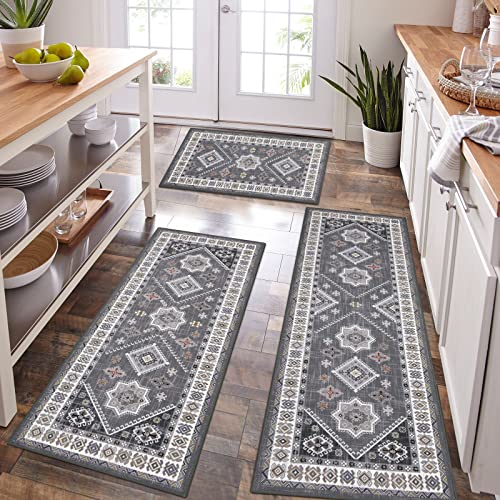
If appearance matters as much as floor protection, the HEBE Boho 3-piece set is worth considering.
The three-piece layout is useful for kitchens with several working zones. You can position the rugs around the sink, stove, island, or prep counter instead of trying to make one large rug cover everything.
The set is also available in coordinated patterns and sizes, with one current listing showing a 20 × 32-inch, 20 × 47-inch, and 20 × 59-inch configuration.
Why I Like the HEBE Boho Set
The main reason to choose HEBE is its combination of decorative style and functional coverage.
A kitchen rug doesn’t have to look like a plain utility mat. Boho patterns can add warmth to kitchens with wood cabinets, neutral walls, farmhouse furniture, or natural finishes.
The relatively low profile is also useful in a kitchen because it reduces some of the problems associated with thick rugs, such as cabinet-door interference and difficult vacuuming.
For spills, however, remember that absorbent fabric and waterproof protection are not the same thing. A rug can absorb a small splash without being completely waterproof. If water reaches the hardwood underneath, clean it promptly rather than leaving the rug wet for hours.
Pros
- Attractive boho patterns
- Three-piece layout protects multiple areas
- Good option for decorative kitchens
- Low-profile design is easier to use around cabinets
- Machine-washable according to available product information
- Useful for sink, stove, and prep zones
Cons
- Less cushioning than dedicated anti-fatigue mats
- Patterns may not suit minimalist kitchens
- Larger spills still require quick cleanup
- Edges may need to be flattened after unpacking or washing
- Backing should be checked against your specific hardwood finish
Best For
Homeowners who want decorative kitchen rugs rather than plain anti-fatigue mats.
My Recommendation
Pick HEBE if you want your kitchen rugs to contribute to the room’s appearance. The three-piece design is particularly useful when you need multiple kitchen mats for hardwood floors rather than one single rug.
3. KMAT Kitchen Mat [2 PCS] Cushioned

If you spend a lot of time standing while cooking, KMAT is the most function-focused option in this group.
Instead of behaving like a traditional fabric rug, this type of kitchen mat focuses on anti-fatigue cushioning, water resistance, and easy cleaning.
That makes it particularly useful in front of the sink, stove, or food-preparation area.
Why KMAT Stands Out
Standing on hardwood for long periods can become uncomfortable. A cushioned kitchen mat provides a softer surface than the floor itself and can be a better choice for people who regularly spend long cooking sessions in the kitchen.
The original product information describes KMAT as using a PVC core with ergonomic foam and a waterproof surface. That combination makes it different from the softer textile rugs in this article.
The waterproof top is especially useful around the sink because water can be wiped away instead of immediately soaking into a fabric surface.
However, waterproof does not mean you can leave standing water underneath the mat indefinitely. Hardwood floors still benefit from prompt spill cleanup and good airflow.
Pros
- Strong anti-fatigue cushioning
- Water-resistant/waterproof surface
- Easy to wipe clean
- Durable PVC construction
- Good choice for long cooking sessions
- Non-slip design is useful on sealed hard floors
Cons
- Thicker than many fabric kitchen rugs
- May interfere with doors if clearance is limited
- Firm feel may not appeal to people who prefer soft textile rugs
- Less decorative than patterned rugs
- Floor compatibility should be checked before use on delicate finishes
Best For
Serious home cooks, people who stand for long periods, and anyone prioritizing comfort over decorative styling.
My Recommendation
KMAT is my top choice when anti-fatigue performance is more important than traditional rug appearance. If you spend an hour or more cooking at a time, this type of cushioned mat makes more sense than a thin decorative runner.
4. Eqivei Kitchen Rugs (Set of 2)

The eqivei 2-piece set is designed for people who want kitchen floor protection without a bulky-looking mat.
The low-profile appearance works particularly well in apartments, rental homes, modern kitchens, and spaces where you want the hardwood floor to remain visually prominent.
Current product information for this type of eqivei set describes two pieces with a long runner and smaller mat, along with a non-slip rubber backing.
Why I Like eqivei
The biggest advantage is the thin, understated profile.
A thick kitchen mat can become visually distracting, especially in a minimalist kitchen. A low-profile rug blends into the room more easily while still providing a little cushioning and a barrier between everyday kitchen activity and the floor.
The black color can also hide certain darker marks, although lint and light dust may be more visible.
For hardwood, the important thing is not simply whether a rug has a non-slip backing. You also need to consider how the backing interacts with your floor finish. Always follow the flooring and rug manufacturer’s instructions.
Pros
- Low-profile design
- Minimalist appearance
- Two-piece set
- Non-slip backing
- Machine washable according to available product information
- Easy to position around the sink and prep area
- Less likely to interfere with doors than thicker mats
Cons
- Less cushioning than KMAT
- Black can show light lint and dust
- Not designed to replace a waterproof anti-fatigue mat
- Large spills require quick cleanup
- Thin construction may feel less comfortable during very long cooking sessions
Best For
Renters, minimalists, modern kitchens, and anyone who wants a discreet kitchen rug.
My Recommendation
Choose eqivei when your priority is low-profile floor protection and a clean visual appearance. It is a better fit for someone who doesn’t want a thick kitchen mat dominating the space.
5. Pauwer Kitchen Mats 3 Piece Set

The Pauwer 3-piece set is the decorative choice for homeowners who prefer a warm farmhouse appearance.
The three-piece arrangement gives you more flexibility than a single runner. You can use the pieces around the sink, stove, island, or entry area depending on the layout of your kitchen.
Why I Like Pauwer
The main attraction is its combination of coverage, texture, and farmhouse styling.
A thicker textile surface can feel more comfortable than a very thin rug. It also adds visual warmth to kitchens with wood cabinets, neutral colors, rustic furniture, or farmhouse décor.
The downside is maintenance. A thicker or higher-pile rug can hold more crumbs and may take longer to dry after washing. That means it requires more regular vacuuming than a flat, low-pile kitchen rug.
Pros
- Warm farmhouse appearance
- Three-piece configuration
- Comfortable underfoot
- Covers multiple kitchen zones
- Good option for decorative kitchens
- Non-slip backing helps keep the pieces in position
Cons
- Thicker pile can collect crumbs
- May require more frequent vacuuming
- Can take longer to dry
- May interfere with some doors
- Not a substitute for a waterproof mat around large spills
Best For
Farmhouse kitchens, style-conscious homeowners, and people who prefer softer textile rugs.
My Recommendation
Pauwer is the better choice when appearance and comfort matter more than having the thinnest possible rug. It gives a kitchen a warmer, more traditional look.
Kitchen Rug Comparison: Which One Should You Buy?
Here’s the quick breakdown:
| If You Want… | Choose… |
| Best overall comfort | KMAT |
| Best budget option | SUMLANS |
| Best decorative option | HEBE |
| Best minimalist option | eqivei |
| Best farmhouse style | Pauwer |
| Best anti-fatigue support | KMAT |
| Multiple kitchen zones | HEBE or Pauwer |
| Low-profile design | eqivei |
| Traditional textile feel | Pauwer or HEBE |
| Affordable two-piece coverage | SUMLANS |
What Makes a Kitchen Rug Good for Hardwood Floors?
Not every kitchen rug is a good match for hardwood.
When shopping, focus on these seven factors.
1. Non-Slip Backing
A kitchen rug that slides every time you step on it is a safety problem.
Look for a rug with a backing designed to improve traction on smooth hard floors. Non-slip rubber, TPR, and similar materials are commonly used in kitchen rugs.
But don’t assume that every rubber-backed rug is automatically suitable for every hardwood finish.
The condition and finish of your floor matter.
2. Hardwood-Safe Backing
This is one of the most important considerations that many buying guides overlook.
The backing sits directly against your hardwood. Depending on the material, moisture, heat, finish, and length of contact, some backings may not be appropriate for certain floors.
If your hardwood floor is newly finished, manufacturer guidance should take priority.
For older sealed floors, look for a rug designed for hard flooring and test it in a hidden location first.
What About Rubber-Backed Kitchen Rugs?
Rubber-backed rugs can provide excellent grip, but “rubber-backed” alone does not tell you whether a particular rug is suitable for your hardwood finish.
The safer approach is:
- Check the flooring manufacturer’s instructions.
- Check the rug manufacturer’s backing recommendations.
- Make sure the floor is clean and completely dry.
- Test a small hidden area.
- Lift the rug periodically to inspect the floor.
- Never leave a wet rug sitting on hardwood.
Some current kitchen-rug guides specifically emphasize non-slip backing, low profile, and washable materials as important features for hard floors.
3. Low-Pile Construction
Low-pile kitchen rugs are often easier to live with than thick rugs.
They:
- Collect fewer crumbs
- Are easier to vacuum
- Fit beneath doors more easily
- Create less of a trip hazard
- Are easier to move for cleaning
- Usually dry faster
A low-pile rug may not feel as soft as a thick anti-fatigue mat, though. That’s why your choice should depend on whether you prioritize comfort or easy maintenance.
4. Washability
Kitchen rugs experience food, grease, water, crumbs, and heavy foot traffic.
A washable kitchen rug is therefore a practical choice.
Look for:
- Machine-washable construction
- Easy-dry material
- Stain resistance
- Colorfastness
- Simple care instructions
Do not assume that a rug is dryer-safe simply because it is machine washable. Always follow the current care label.
5. Water Resistance
A kitchen rug does not need to be completely waterproof to be useful.
However, around the sink, water resistance can be a major advantage.
There is an important difference:
Absorbent rug: catches and holds small spills.
Water-resistant rug: slows moisture penetration.
Waterproof mat: provides a stronger barrier against liquids.
For hardwood floors, quick cleanup is still important regardless of the rug type.
6. Thickness
Think about where the rug will go.
A thick anti-fatigue mat may be excellent in front of a sink but problematic beneath a cabinet door.
Before buying, check:
- Door clearance
- Cabinet clearance
- Rug thickness
- Edge height
- Transition areas
7. Size
Don’t choose a kitchen rug simply because it looks good in a product photo.
Measure your space first.
Common kitchen rug placements include:
In Front of the Sink
A small mat can cover the area where you stand while washing dishes.
Along a Counter
A runner works well for long prep counters.
Between an Island and Counter
A narrow runner can define the main walking and working zone.
Multiple Work Areas
A two- or three-piece set can place individual rugs near the sink, stove, and prep counter.
What Size Kitchen Rug Should You Buy?
The best size depends on the layout.
Small Kitchen
A smaller 2 × 3-foot style mat can work well in front of the sink.
Long Counter
A runner is often a better choice than several small rugs.
Galley Kitchen
A longer runner can cover the main working path without filling the entire room.
Large Kitchen
A multi-piece set may work better because you can protect several working zones without covering the whole floor.
Always leave enough clearance around doors and appliances.
Kitchen Rugs vs. Kitchen Mats: What’s the Difference?
The terms are often used interchangeably, but there is a practical difference.
A kitchen rug is generally more focused on appearance, texture, and decorative appeal.
A kitchen mat is usually more focused on function, such as:
- Anti-fatigue cushioning
- Water resistance
- Non-slip grip
- Easy cleaning
For example, KMAT makes more sense when standing comfort is your priority, while HEBE or Pauwer may make more sense if you want the floor covering to contribute strongly to your kitchen décor.
Are Kitchen Rugs Safe for Hardwood Floors?
They can be, but the rug itself isn’t the only factor.
The safest approach is to consider:
- Backing material
- Floor finish
- Moisture
- Rug breathability
- Cleaning frequency
- Rug movement
- Whether the floor is newly refinished
Don’t leave wet rugs on hardwood for long periods.
Also, periodically lift the rug and inspect the floor underneath. If you see discoloration, residue, moisture, or a change in the finish, stop using the rug until you determine the cause.
Can Kitchen Rugs Scratch Hardwood Floors?
A soft rug surface generally isn’t what causes scratching.
The bigger concern is what gets trapped underneath it.
Sand, grit, food particles, and other abrasive debris can become trapped between the rug and hardwood. When the rug moves across the floor, those particles can potentially act like sandpaper.
To reduce the risk:
- Vacuum or sweep the floor regularly.
- Shake or wash the rug as appropriate.
- Keep the underside clean.
- Avoid dragging rugs across hardwood.
- Lift rugs when moving them.
- Check for debris underneath periodically.
How Do You Stop a Kitchen Rug From Sliding on Hardwood?
Start with a rug specifically designed for hard floors and check that the backing is compatible with your flooring.
If additional grip is needed, consider a rug pad designed specifically for hardwood floors.
Avoid using random adhesives or tapes unless both the flooring and rug manufacturers approve them.
A rug that moves should not simply be ignored. Movement can create a trip hazard and can also cause friction against the floor.
Are Washable Kitchen Rugs Good for Hardwood Floors?
Yes, washable kitchen rugs can be an excellent option because kitchens get dirty quickly.
The important point is to dry the rug completely before putting it back on hardwood.
Never put a wet or damp rug back on the floor and leave it there.
Washable rugs are especially useful for:
- Families
- Busy cooks
- Homes with pets
- Kitchens near sinks
- High-traffic kitchens
- People who frequently deal with food spills
Washable, low-profile, non-slip kitchen rugs are a particularly popular combination because they balance maintenance, safety, and convenience.
What Type of Material Is Best for a Kitchen Rug?
There isn’t one perfect material.
Polyester
Good for:
- Washability
- Softness
- Everyday kitchen use
Polypropylene
Good for:
- Durability
- Stain resistance
- Low-pile designs
Chenille
Good for:
- Softness
- Absorbency
- Comfortable underfoot feel
PVC/Foam
Good for:
- Anti-fatigue cushioning
- Water resistance
- Easy wiping
Cotton
Good for:
- Natural feel
- Breathability
But cotton can absorb spills and may require more care.
The best material depends on whether you prioritize comfort, cleaning, water resistance, or appearance.
Are Anti-Fatigue Mats Safe for Hardwood Floors?
An anti-fatigue mat can be a great choice for a kitchen with hardwood, especially if you stand for long periods.
However, don’t choose one based on cushioning alone.
Check:
- Backing material
- Floor compatibility
- Moisture resistance
- Edge design
- Thickness
- Manufacturer instructions
KMAT is the strongest fit among these five products if anti-fatigue support is your primary goal.
How to Care for Kitchen Rugs on Hardwood Floors
Proper maintenance is just as important as choosing the right rug.
Vacuum Regularly
Remove crumbs, dirt, sand, and other abrasive particles before they accumulate underneath the rug.
Clean Spills Quickly
Don’t wait for water or other liquids to soak through.
Wash According to Instructions
If the rug is machine washable, follow the manufacturer’s instructions rather than assuming any wash cycle is safe.
Dry Completely
This is especially important for hardwood floors.
Check the Underside
Look for:
- Moisture
- Dirt
- Residue
- Cracking
- Backing deterioration
- Changes in the floor finish
Rotate or Reposition
Moving the rug occasionally can help you inspect the floor and prevent long-term accumulation of dirt and moisture in one area.
What We Looked For When Comparing These Kitchen Rugs
For a hardwood-floor kitchen rug, I would evaluate products across these categories:
Hardwood compatibility — 20%
Does the design make sense for use on a finished hardwood floor?
Non-slip performance — 20%
Does the backing help keep the rug in place?
Washability and maintenance — 15%
Can you realistically keep it clean in a busy kitchen?
Comfort — 15%
Does it make standing more comfortable?
Water protection — 10%
How well does it handle everyday splashes?
Durability — 10%
How well should the materials hold up to regular kitchen traffic?
Style and value — 10%
Does the design offer good value for the intended use?
These categories are more useful than judging a kitchen rug by appearance alone. Current kitchen-rug guides also tend to prioritize features such as washability, non-slip construction, low profile, comfort, and durability.
Frequently Asked Questions About Kitchen Rugs for Hardwood Floors
What type of rug backing is safest for hardwood floors?
There isn’t one backing material that is automatically safe for every hardwood finish. Check both the rug and flooring manufacturer’s recommendations, especially if your floor is newly refinished. Test an inconspicuous area before using the rug throughout the kitchen.
Are rubber-backed kitchen rugs safe for hardwood?
They can be, but it depends on the particular backing and hardwood finish. Don’t assume that every rubber-backed rug is compatible with every hardwood floor. Check the manufacturer’s instructions and monitor the floor for discoloration or residue.
Can kitchen rugs damage hardwood floors?
They can cause problems if moisture, dirt, incompatible backing materials, or abrasive debris become trapped underneath. Regular cleaning, prompt spill removal, and periodic inspection can reduce these risks.
Can kitchen rugs scratch hardwood floors?
The rug itself isn’t necessarily the problem. Dirt, sand, crumbs, and other abrasive particles trapped underneath can cause scratches if the rug moves across the floor. Keep both the rug and floor clean.
How do I stop a kitchen rug from sliding on hardwood?
Choose a non-slip rug designed for hard flooring. If necessary, use a rug pad specifically approved for hardwood floors. Avoid unapproved adhesives that could damage the floor finish.
What size rug is best in front of a kitchen sink?
Measure the space first. A small mat is usually enough for a single sink, while a longer runner can work better along a large counter or island. Leave enough clearance for cabinet and appliance doors.
Are washable kitchen rugs safe for hardwood floors?
They can be. The most important rule is to make sure the rug is completely dry before placing it back on hardwood. Also check the backing and floor compatibility.
Are anti-fatigue mats good for hardwood floors?
They can be an excellent choice for people who spend long periods standing in the kitchen. Look for a mat with a backing that is suitable for your hardwood finish and enough cushioning for your needs.
Should you use a rug pad under a kitchen rug?
A rug pad can help improve grip and provide another layer between the rug and floor, but it must be specifically designed for hardwood floors. Avoid pads that contain materials your flooring manufacturer doesn’t recommend.
What is the best material for a kitchen rug?
For easy maintenance, polyester and polypropylene are popular choices. For cushioning, foam/PVC mats can be better. Chenille offers softness and absorbency, while cotton provides a more natural feel but can absorb more moisture.
Are low-pile kitchen rugs better?
They are often easier to vacuum, less likely to interfere with doors, and easier to maintain. However, they generally provide less cushioning than thicker anti-fatigue mats.
How often should you wash a kitchen rug?
It depends on traffic and how much food or moisture the rug encounters. High-traffic kitchen rugs may need frequent cleaning, while lightly used decorative rugs can go longer. Follow the manufacturer’s care instructions.
Can I use these kitchen rugs on laminate or tile floors?
Many kitchen rugs are designed for multiple hard-floor surfaces, but always check the product instructions. The backing and floor finish still matter, particularly on delicate surfaces.
Can I use a kitchen rug over radiant-heated hardwood floors?
Check both the flooring and rug manufacturer’s instructions first. A rug can change how heat reaches the surface, so compatibility should not be assumed.
Final Verdict: Which Kitchen Rug Should You Buy?
The KMAT Kitchen Mat is my top pick if your priority is comfort, anti-fatigue support, and water resistance. It makes the most sense for people who spend long periods cooking or standing at the sink.
The SUMLANS Kitchen Mat Set is the better choice if you’re looking for affordable two-piece coverage and everyday comfort.
Choose HEBE if you want a decorative boho appearance and multiple rugs for different kitchen zones.
Choose eqivei if you prefer a thin, minimalist rug that doesn’t visually dominate your hardwood floor.
Finally, Pauwer is a strong option for farmhouse-style kitchens where comfort and decorative appeal are equally important.
The most important thing is not simply finding a rug labeled “best for hardwood floors.” Look at the backing, moisture protection, thickness, washability, size, grip, and compatibility with your particular hardwood finish.
A good kitchen rug should make your kitchen more comfortable without creating a new problem for the floor underneath.