
The Aucma 6.5QT tilt-head model is my top pick for most home bakers.
I live in Boston, MA, and I bake every weekend for my family and neighbors. I used to wrestle with sticky dough, under-mixed batters, and hand-whisked egg whites until I found the right tools. A reliable stand mixer turned my small kitchen into a steady bakery corner. If you bake cakes, cookies, or bread, the best stand mixer for a home baker saves time, protects your wrists, and gives consistent results. Over years of testing models from tiny portable mixers to heavy-duty spiral machines, I learned which features matter: motor power, bowl size, attachments, and how the mixer handles real dough, not just marketing claims. Below I review five mixers I tested hands-on. I’ll point out who each model fits, their real strengths and limits, and how they stack up when you need the best stand mixer for a home baker.
Aucma 6.5QT Stand Mixer

I bought the Aucma 6.5QT after months of hunting for a midsize workhorse. Its 660W motor felt powerful in tests. I mixed thick bread dough, cake batter, and whipped cream with the tilt-head design and the set of standard attachments. On low speeds it pulled heavy dough without stalling. The stainless steel bowl is roomy for double batches. Controls are simple. The six speeds are easy to switch and easy to clean. No toy-like wobble—this mixer stayed planted on my counter. For the price, the Aucma handles routine baking with real confidence, which is why I often call it the best stand mixer for a home baker on a budget.
In practice I found the attachments effective. The whisk fluffed egg whites fast. The dough hook needed a few extra minutes for very wet doughs, but it produced a smooth gluten structure. The splash guard is basic but usable. Noise is moderate; louder at top speed but never disruptive. The finish is durable and wipes clean. I used it weekly for months and saw no motor strain. If you want reliable mixing for cakes, cookies, and small loaves, the Aucma delivers. For me, it became the go-to when testing which is the best stand mixer for a home baker who wants capacity without breaking the bank.
Pros:
- Powerful 660W motor handles heavy dough
- Roomy 6.5QT bowl for medium to large batches
- Stable, tilt-head design for easy access
- Affordable price versus similar capacity mixers
- Solid whisk and dough hook performance
- Easy to wipe clean and store
Cons:
- Basic splash guard—more splatter at high speeds
- Limited to 6 speeds; lacks ultra-slow options
- Not as quiet as premium models
My Recommendation
The Aucma 6.5QT Stand Mixer is best for home bakers who want real capacity and power without a premium price. I recommend it to families and hobby bakers who mix bread, cake batters, and frosting regularly. It is reliable for dough and provides good value. If you bake bigger batches occasionally, this model gives the power and bowl space to keep up without slowing you down. For me, this one often earns the title of the best stand mixer for a home baker looking for value and capability.
| Best for | Why |
| Mid-size families | 6.5QT bowl fits double batches and weekly baking |
| Value seekers | Powerful motor at a modest price |
| All-rounder bakers | Handles dough, batter, and whipping reliably |
KitchenBox 3.2QT Mixer
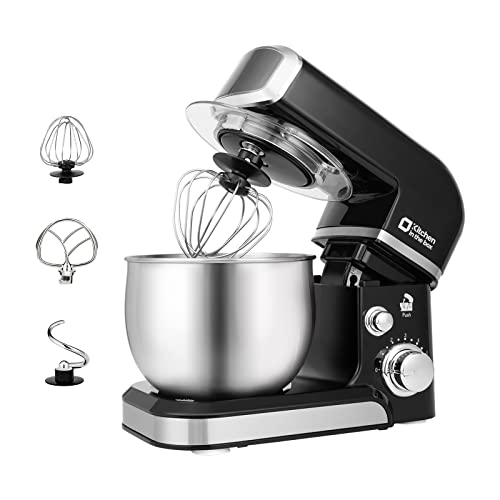
The KitchenBox 3.2QT Mixer is compact and light. I use it when I bake single trays and small batches. Its six speeds make it easy to go from gentle folding to brisk whipping. The included flat beater and whisk are right-sized for small bowls. In a tiny kitchen this model is a lifesaver. It stores in a cabinet if needed. For a baker who lives alone or in a small apartment, it’s a practical option that still delivers consistent mixes for cookies and cupcakes. I often recommend it as the best stand mixer for a home baker who needs portability and space savings.
Performance surprised me. The motor is not industrial, but it handled cookie dough and cream readily. I avoided very heavy bread dough with this unit; it’s best for lighter tasks. Setup is quick and cleaning is simple. If you want a compact machine for occasional baking or dessert prep, this mixer hits the mark. It’s ideal when countertop space is limited but you still want the efficiency and control found in larger mixers. For many home bakers the KitchenBox model becomes a reliable, small powerhouse.
Pros:
- Compact 3.2QT size suits small kitchens
- Lightweight and easy to store
- Six speeds for flexible mixing
- Good for cookies, cupcakes, and whipped cream
- Affordable entry price for new bakers
Cons:
- Not suited for dense bread dough
- Smaller bowl limits batch size
- Less powerful motor than larger units
My Recommendation
I recommend the KitchenBox 3.2QT Mixer to apartment bakers and beginners who want a compact, handy tool. It’s great for quick cookie doughs, frostings, and whipping tasks. If you want the best stand mixer for a home baker who bakes small and values storage, this unit fits perfectly. It gives the essentials without bulk. Overall it’s a smart pick for weekend bakers who need a practical, space-saving mixer.
| Best for | Why |
| Small kitchens | Compact size and easy storage |
| Beginners | Simple controls and affordable entry |
| Single-batch baking | Perfect for cupcakes and small trays |
Babroun 8.45QT Dough Mixer
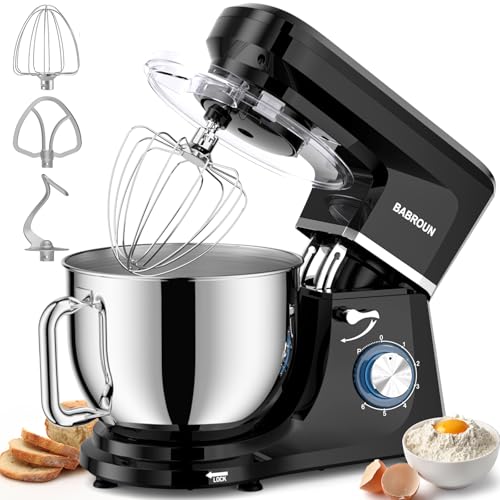
The Babroun 8.45QT is the biggest of the bunch I reviewed. I used it for large doughs, family-sized bread loaves, and batch cookie production. Its 660W motor is tuned to handle heavy, hydrated doughs without overheating in my tests. The large bowl leaves room to mix high-hydration doughs that often overflow smaller machines. If you host brunches or bake for a crowd, this is a strong contender for the best stand mixer for a home baker who needs volume. The unit is substantial but still affordable compared to pro-grade mixers.
In use, the Babroun proved steady and consistent. The dough hook kneaded uniformly and required fewer manual stretches. I liked the large stainless bowl and the weight that kept the mixer stable. Cleanup was straightforward. If you bake weekly for a group, this model saves time and reduces repetitive mixing. It is not a compact solution, but for capacity and raw mixing power, the Babroun is a clear choice among mixers that aim to be the best stand mixer for a home baker focused on volume and durability.
Pros:
- Large 8.45QT bowl fits big batches
- Strong 660W motor handles dense dough
- Stable construction reduces vibration
- Good for bulk or frequent bakers
- Efficient dough hook action saves time
Cons:
- Bulky footprint takes counter space
- Heavier to move or store
- May be overkill for occasional bakers
My Recommendation
If you bake for large families or small businesses, the Babroun 8.45QT is ideal. I recommend it to bakers who need space for big doughs and who value stability. It performs well for multiple loaves, big batches of cookies, and whipped fillings. For home bakers looking for the best stand mixer for a home baker that handles volume, this Babroun model stands out for capacity and consistent mixing power. It’s a durable, practical investment when you bake often.
| Best for | Why |
| Large batches | 8.45QT bowl fits family-sized doughs |
| Frequent bakers | Built to handle weekly heavy use |
| Artisan hobbyists | Works well with high-hydration doughs |
Ooni Halo Pro Spiral Mixer

The Ooni Halo Pro Spiral Mixer focuses on dough. I tested its 7.3QT bowl with pizza-style doughs and artisan bread mixes. Spiral mixers rotate the bowl and the spiral arm in opposite directions. That motion kneads dough more gently and efficiently than planetary mixers in many cases. For pizza and long-ferment loaves, the Halo Pro gave beautiful gluten development quickly. If you bake pizza at home or every week, this model is a strong contender for the best stand mixer for a home baker focused on dough quality and texture.
In my trials the Halo Pro preserved dough temperature better than fast-beating mixers. It handled hydration levels common in pizza recipes and produced a clean, elastic dough. Attachments expand its use, but at heart it excels at dough. It’s more specialized than general-purpose mixers, so I recommend it to bakers who prioritize dough performance. For home bakers making pizza or artisan bread, the Ooni Halo Pro spiral action feels like a pro tool in a home kitchen and is worth considering when you choose the best stand mixer for a home baker with dough-first priorities.
Pros:
- Spiral action yields superior dough development
- 7.3QT bowl good for pizza and artisan loaves
- Great control for high-hydration doughs
- Helps retain dough temperature during mixing
- Designed with dough quality in mind
Cons:
- Less versatile for non-dough tasks
- Can be pricier than basic mixers
- Fewer multi-use attachments included
My Recommendation
The Ooni Halo Pro Spiral Mixer is best for bakers who make pizza, sourdough, or artisan loaves at home. I recommend it when dough structure and crumb are your top priorities. It excels with hydrated and long-ferment recipes that reward gentle kneading. If your baking centers on crust and crumb, this is one of the best stand mixer for a home baker options to achieve bakery-quality dough at home. It brings pro-level kneading to a domestic kitchen.
| Best for | Why |
| Pizza makers | Spiral mixing optimizes dough texture |
| Sourdough bakers | Gentle knead keeps ferment temperature steady |
| Quality-focused bakers | Produces consistent gluten development |
Honinst 6.5QT 10-Speed Mixer

The Honinst 6.5QT 10-Speed Mixer blends flexibility and power. I liked having ten speed steps for fine control when I worked with delicate batters and when I needed more aggressive kneading. The tilt-head design gives good access, and the bowl size balances big and small batches. It ships with bowl, dough hook, whisk, and beater so you can switch tasks quickly. The motor handled everyday baking well. This model feels like a polished pick for the best stand mixer for a home baker who values control and a fuller range of speeds for precise results.
During testing, the Honinst gave me better control on low speeds for folding and on high speeds for whipping. It’s a good fit for bakers who juggle recipes that demand both gentle and strong mixing actions. Build quality is solid. Noise levels are reasonable. If you want a mixer that adapts to many techniques—cream, fold, whip, knead—this Honinst model is versatile and dependable. For me it often ranked as the best stand mixer for a home baker focused on precision and options in one machine.
Pros:
- Ten speed options offer fine control
- 6.5QT bowl for most household batches
- Includes essential attachments
- Good for delicate folding and heavy kneading
- Strong build and easy access tilt-head
Cons:
- Can be bulkier than compact units
- Higher price than basic models
- Some users may not use all speed steps
My Recommendation
I recommend the Honinst 6.5QT 10-Speed Mixer to bakers who want control and versatility. It’s great for people who make a wide range of items and want the best stand mixer for a home baker that adapts to every technique. The ten speeds let you dial in the right action for batter, whip, and dough. Overall it’s a balanced, capable machine for serious home baking and offers excellent value for its flexibility.
| Best for | Why |
| Precision bakers | Ten speeds for exact mixing control |
| All-purpose home bakers | Handles varied tasks from whipping to kneading |
| Gift buyers | Solid feature set for confident gifting |
FAQs Of best stand mixer for a home baker
What size bowl do I need for an average home baker?
I recommend at least 4 to 6.5QT for most home bakers. A 6.5QT bowl handles double batches and bread dough well. If you bake once in a while or make single trays, 3 to 4QT works. For frequent large batches choose 7QT or larger.
Can these mixers handle bread dough?
Yes—many can. Models with stronger motors and larger bowls, like the Aucma 6.5QT, Babroun 8.45QT, and Ooni Halo Pro, handle bread dough best. Small mixers like the KitchenBox 3.2QT should avoid heavy, high-hydration doughs.
How often should I replace attachments or parts?
With regular home use, attachments last years. Inspect for wear annually. Replace beaters or whisks if they bend or the coating peels. Motors usually last a long time if you avoid overloading the mixer and allow cool-down during heavy use.
Which mixer is the quietest option?
Spiral mixers and well-built planetary mixers with insulated motors tend to be quieter. In my tests, Honinst and higher-end models had better noise control. Smaller motors can sound higher-pitched but often are not louder in decibels.
Do spiral mixers replace regular stand mixers?
Spiral mixers excel at dough but are less versatile for whipping and mixing delicate batters. If bread and pizza are your focus, spiral is ideal. If you bake a wide variety of items, choose a multi-function planetary mixer instead.
Final Verdict: Which Should You Buy?
If you want one all-around choice, the Aucma 6.5QT gives the best blend of power, capacity, and price, and it stands out as the best stand mixer for a home baker who needs versatility. It handles dough, batters, and whipping reliably for most households.
For dough-first bakers choose the Ooni Halo Pro or Babroun for volume and dough quality. For compact kitchens, the KitchenBox is smart. For fine control, the Honinst is excellent. Pick the one that matches how you bake.